

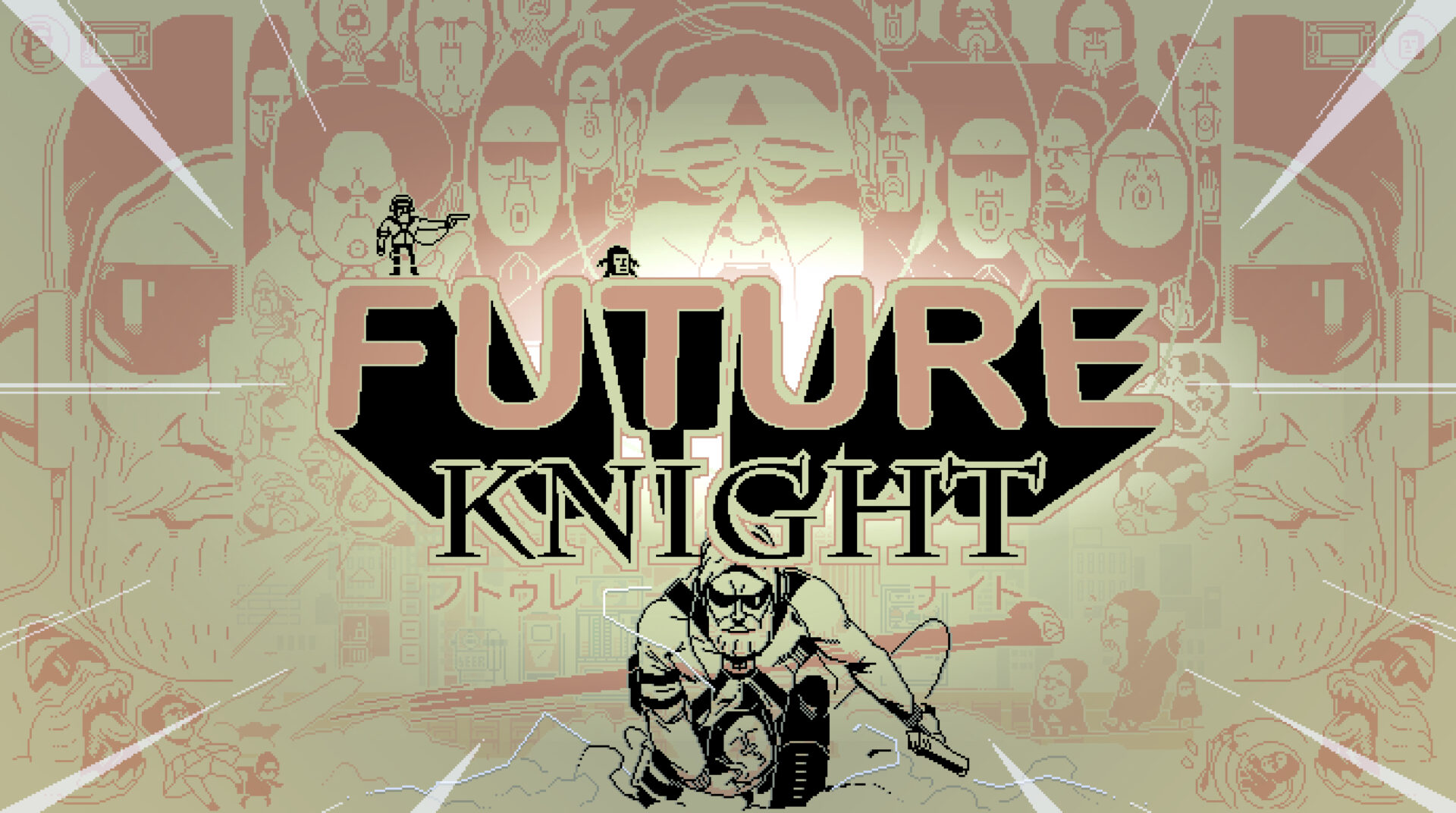


If there has ever been a game that you didn’t know you needed but definitely need to experience, it is Future Knight. It quietly flew under the radar, but knowing that the studio responsible is Studio Koba, it shouldn’t be a total shock that, at least, this game should be something unique. Studio Koba’s legacy is one stapled to the indie retro-like canon with Narita Boy and Haneda Girl.
The Spanish Touch
It is starting to become a trend that Spanish studios create such inherently ‘Japanese’ games that it is almost funny. A month ago, Spanish compatriots Undercoders dropped Denshattack!, which also, in gameplay concept and aesthetics, mixes up authentic Japanese game principles of the early ’00s, the Dreamcast and PS2 heydays.
Future Knight, while completely different from DenshAttack!, has the same all-Japanese vibe. But additionally, it ups that vibe by being unadulteratedly bonkers and totally spaced-out. Man, if any game conjures a completely unique vibe, it is this game.
Game & Watch
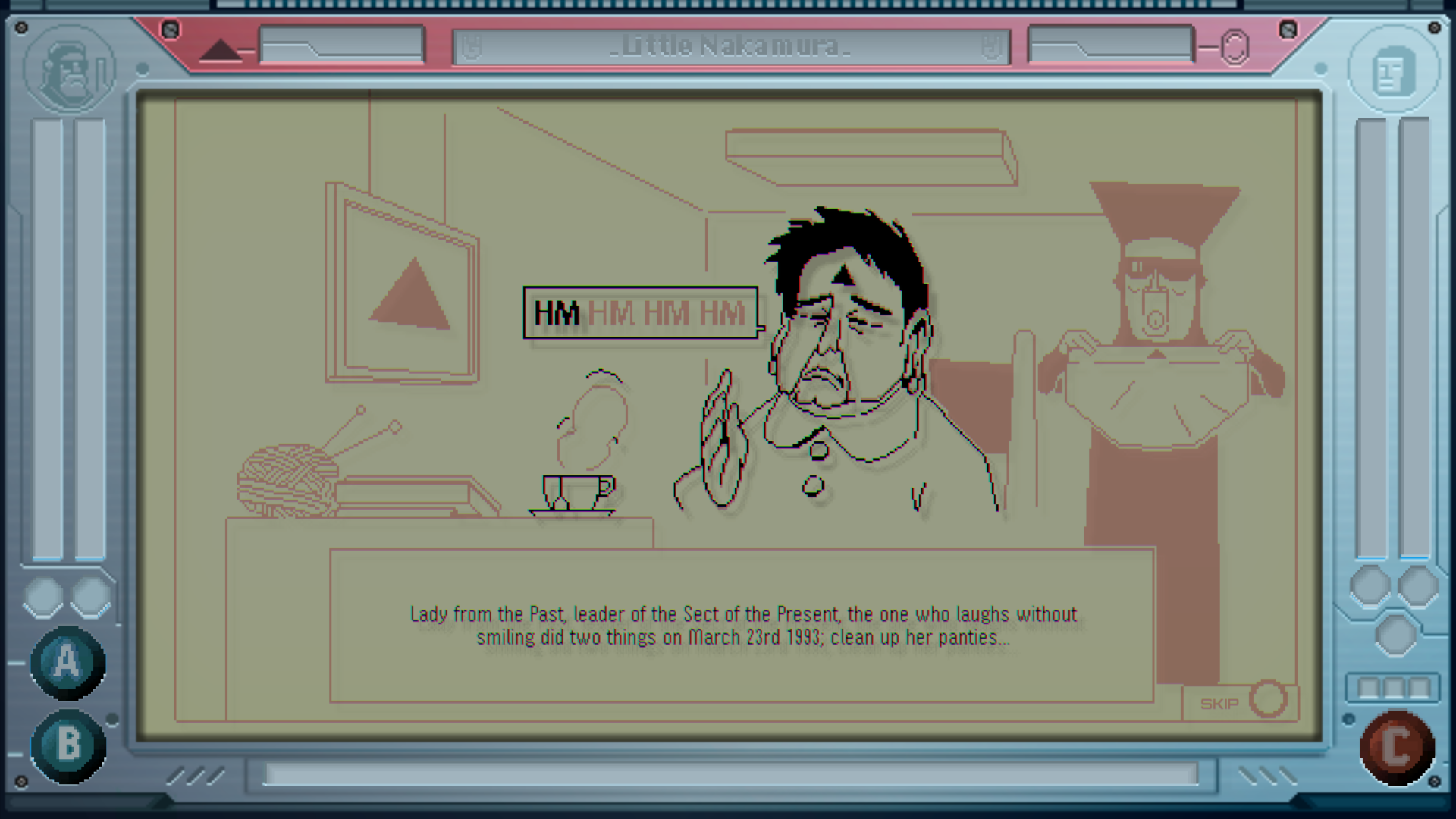
Let’s start with the concept. Powered by Koba’s Eduardo Fornieles’ background as a visual artist, the game takes the concept of the way the ol’ Game & Watch looked and adapts it for a 2D side-scrolling action game. Visually and in the story, it suggests that you are playing on Little Nakamura, an LCD handheld. Within that concept, it animates LCD-looking sprites above a layer of background objects as if it were an LCD game. It does it so cleverly that it builds a format wherein it can animate both 2D platforming gameplay as well as cutscenes in a sort of alien way that is authentically looking, but totally not at the same time.
Little Nakamura
That Little Nakamura isn’t just a visual framing device either, it is baked directly into Future Knight’s world and story. In 1993, the mysterious Lady from the Past brainwashes humanity. Thirty years later, L.P. Nakamura creates Future Knight, a bio-android warrior built to undo the damage. Armed with his Techno-Blaster, accompanied by the fragile mutant Twomore and carrying the Little Nakamura handheld itself, Future Knight is sent back to May 23, 1993, exactly eight hours before the Lady from the Past takes control of mankind. It neatly folds the game’s LCD concept back into its fiction: you’re playing Future Knight through a Little Nakamura while Future Knight himself is carrying a Little Nakamura inside the world displayed on it. From there, the game runs with that deliberately absurd setup, gradually revealing more about the Lady from the Past, Nakamura and Future Knight as you chase her through an increasingly surreal version of 1993.
The real power of Future Knight’s gameplay lies within the way Future Knight and Twomore symbiotically can and have to work together to achieve L.P.’s goal of defeating the Lady. Whenever spaces get too narrow or force fields prevent Future Knight’s limited athletic abilities from progressing, you can ‘eject’ Twomore, a small mutant that can crawl up walls, through narrow spaces and execute an extremely potent dash. The downside is that Twomore is very vulnerable to enemies and hazards. While Future Knight can endure a couple of hits, Twomore can’t handle any.
Two can Play that Game
So you can explore as Twomore, while your Future Knight armor waits at the point of ejection. Twomore can regenerate the armor at its location with the press of a button. In addition to that, Future Knight regenerates after being destroyed, which also opens up a mechanic where you can sacrifice the armor with a certified death jump to sling Twomore on a trajectory towards a far-away wall, for instance. It can also help Twomore survive water traps by tossing Twomore up from below. During the playthrough, all sorts of clever executions within the possibilities of these otherwise simple mechanics expose themselves. The developers aren’t even trying too hard to force you to use them in a puzzle-like manner. The game approaches these mechanics much more relaxed than you might think after reading these past paragraphs. Instead, the game encourages the player to experiment and just have fun. Generally, there is more than one route to a goal, sometimes rewarding you with one of the three triangles you can collect within a stage. Sometimes there is a shortcut, much of the time there are just other ways to go at it.
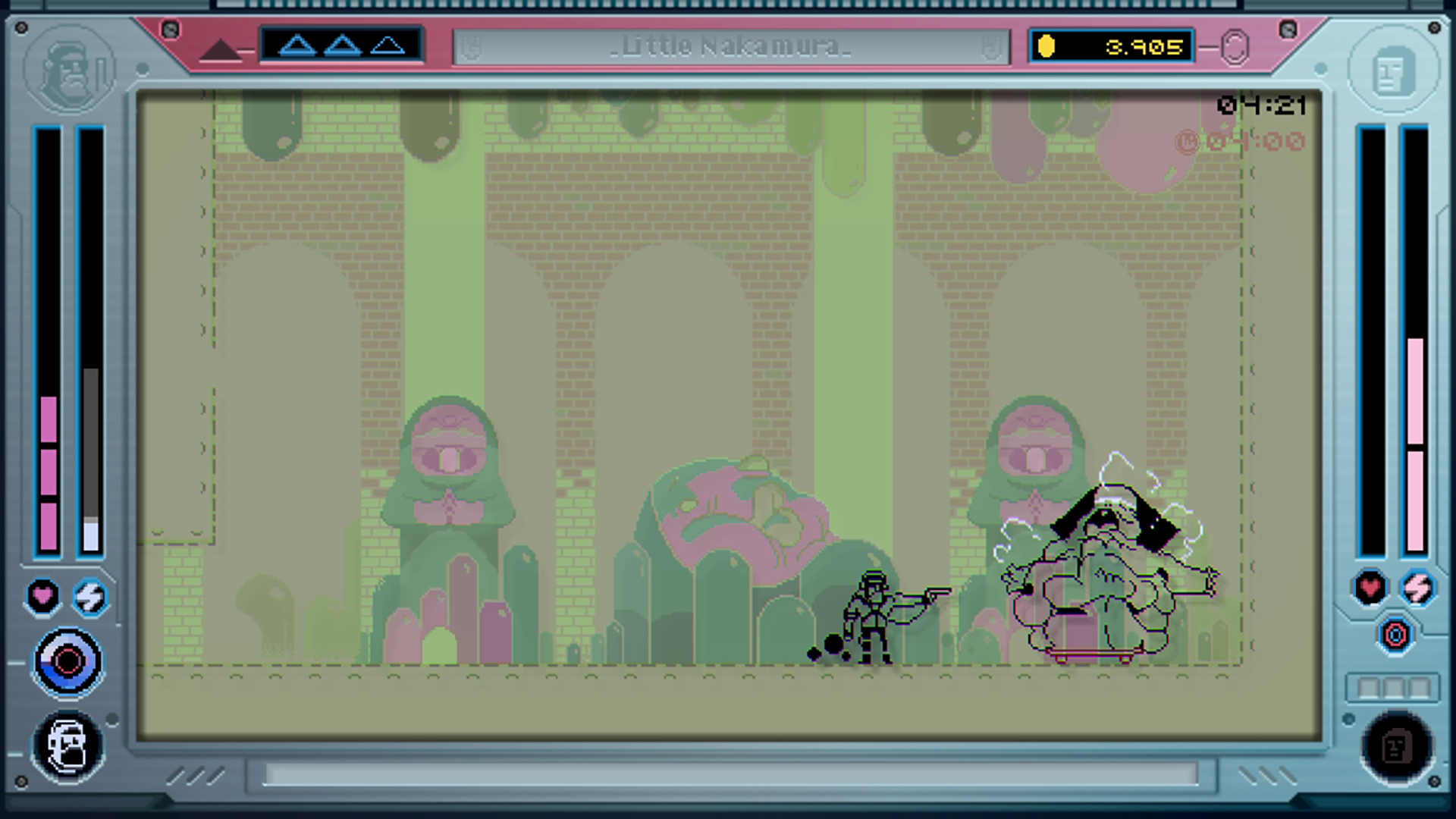
There are intentional puzzle substages that reward you with a triangle. Those are hidden behind doors you can enter along the way. Those puzzle sections aren’t too spicy and are quite manageable, and a nice diversion from the shoot’em-platforming action you have to deal with otherwise.
Speaking of platforming: it feels quite a bit Mega Man-ish with a lot of added agility through its dodge roll and eight-way shooting action. Once four chapters in, you will get comfortable with comboing both protagonists’ abilities. The learning curve is so gradual and game-changing that once you’ve mastered both characters completely, you do want to replay the first stages with your newly gained ‘Now I know Future Knight’ abilities.
Suicide Toddlers
With all these inherently great gameplay features and its visual style, it is weird to say that we haven’t even touched another unique selling point of Future Knight: the character design.
As well as the main cast of curious creatures and techno-beings, the stages are littered with a hugely diverse cast of malformed creatures, without any limits. Mutated toddlers that act like furious suicide bombers while still crying like toddlers, or how about sentient excavators? I can go on and on with examples. But take it from me, with the fact that it is like a comically and cartoonishly animated fever dream, you need to explore it yourself for maximum effect and pleasure.
Bo Selecta!
The last USP that should not go unmentioned is the brilliant music. Completely on par with the rest of the game, it is completely bonkers too. Mixing up numerous genres like ska and dub with pitchy vocalised oohs, aahs and woowoops, if that makes any sense. It is nothing like you’ve ever heard before.
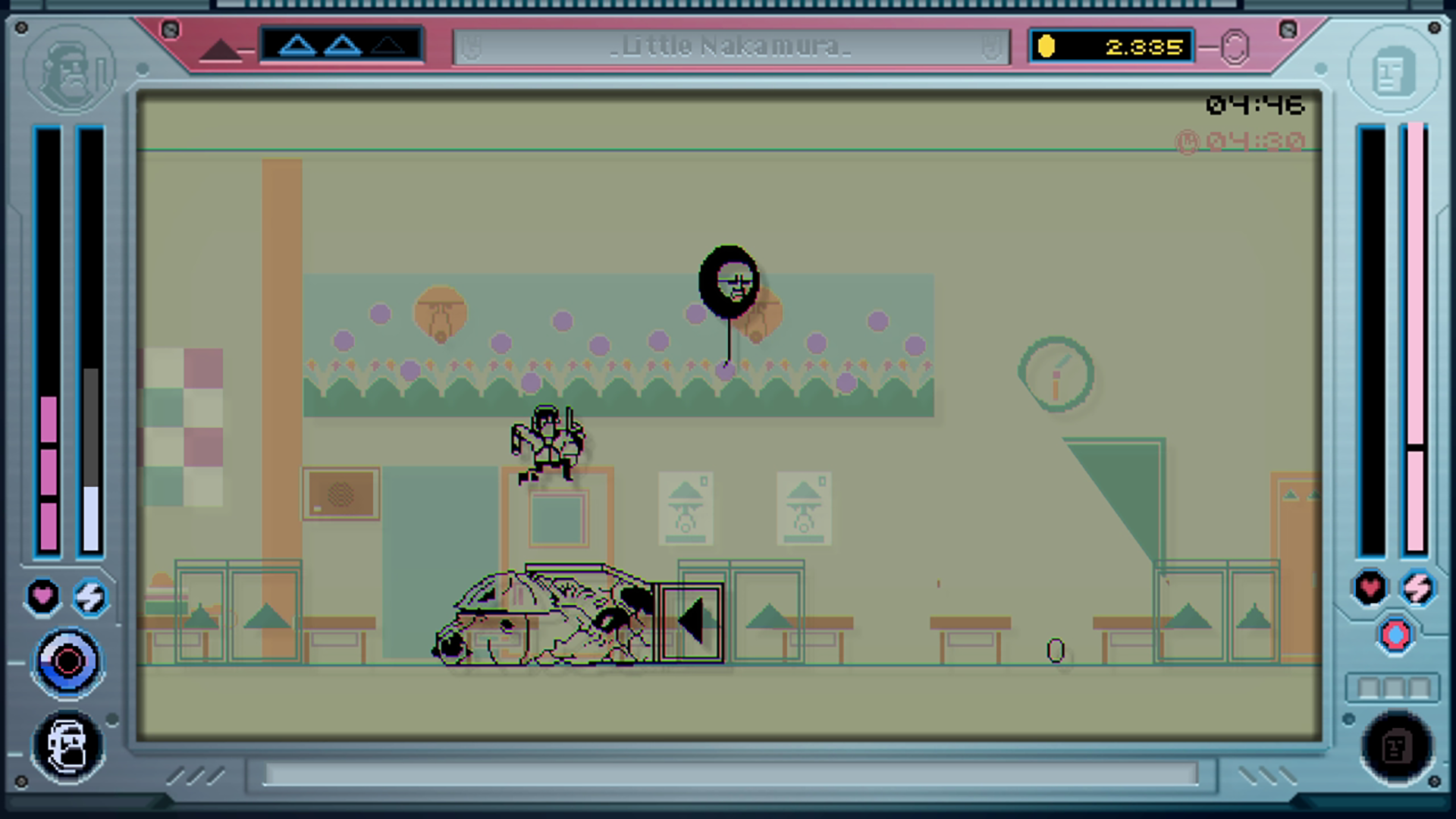
The only downside is that at certain points it suffers from some hangups and one annoying bug where you can basically launch and lock Twomore into a wall with Future Knight. Especially later on in the game, these issues pop up occasionally.
Otherworldly Experience
Without any doubt, Future Knight is a truly unique jam of influences that creates something unworldly that is equally unique and enjoyable in its gameplay as well as to the eye and to the ear. The creators mention Satoshi Kon as a source of inspiration, mainly for his philosophy of not putting any limits on creativity and approach. This is a wholesome gem that needs to be nurtured and held sacred for the sake of its creativity. Its outlandish style may not land with everyone, but even putting aside its style still leaves an undeniably fun platforming game that anyone will enjoy.
Without any doubt, Future Knight is the biggest surprise of the year in the retro-inspired indie subgenre. It comes completely out of left field to leave its mark on the canon of indie retro-inspired video game development. This will sprout copycats and wannabes, for sure, if it manages to find a wide enough audience. It is totally unique in style, both visually and to the ear, but underneath all that weirdness is a fundamentally great platformer that nails the way you can exploit the two protagonists' unique abilities. It is a gem to be nurtured, and the fact that it has largely been overlooked by the major gaming outlets only makes its discovery feel more special. Within our little realm of retro-inspired video gaming we declare this game perfect, except for a couple of minor bugs.
