

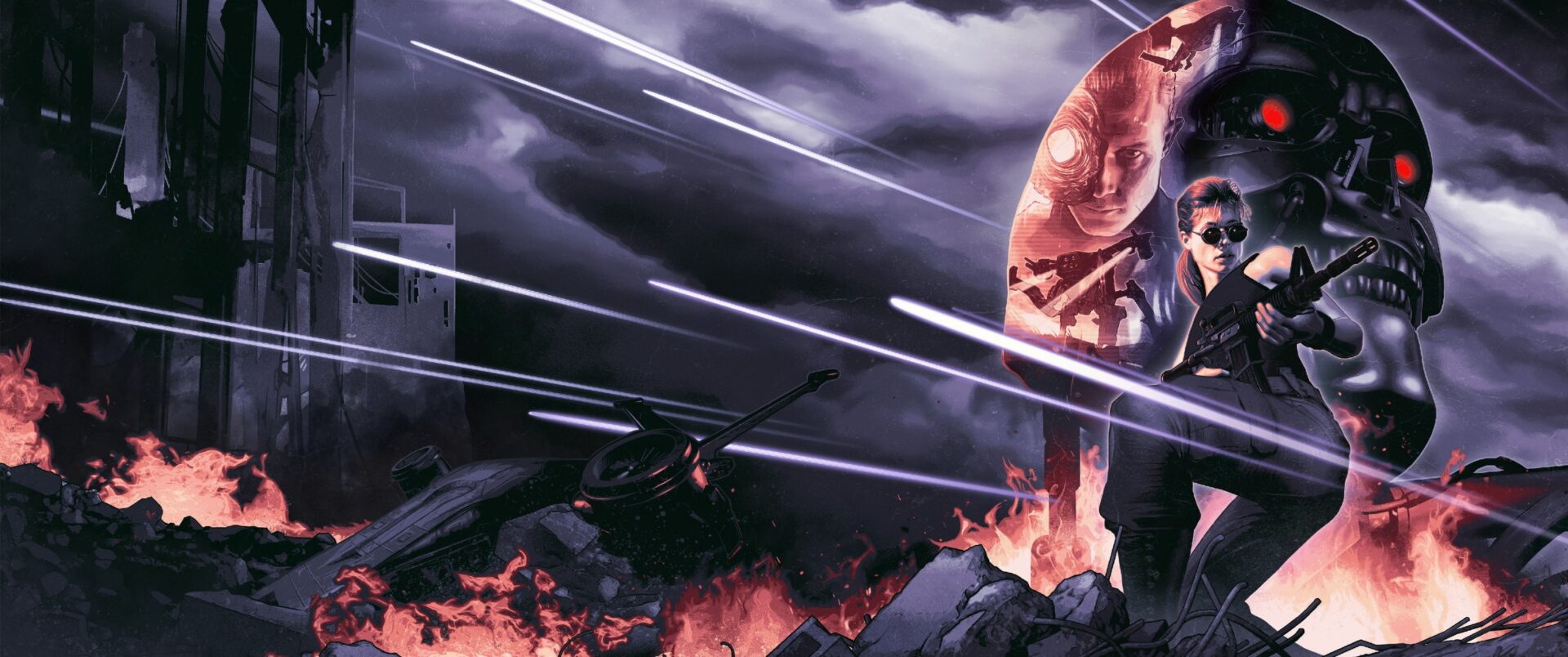

As a teen, I was somehow mesmerized by the PC-DOS port of Terminator 2: Judgment Day. Oblivious to the mediocrity most reviewers of the time branded the game with. While the gameplay clearly had its shortcomings, the way it captured the grim atmosphere, combined with the brooding summer Los Angeles setting and the film’s strong cast, kept drawing me back again and again. It even inspired me to save up for an Amiga, as the screenshots on the back of the box suggested that platform delivered the definitive version.
In the end, my parents sponsored a new “family” PC, which was, unsurprisingly, used exclusively by me. The Amiga never came, but that in itself says something about the impact this game, among others, had on me.

Decades later, Reef Entertainment managed to secure the license and handed it to Bitmap Bureau, resulting in a retro-styled licensed 2D action game: Terminator 2D: No Fate.
Visual lineage and atmosphere
The first thing any gamer with a 1990s background will notice is how closely No Fate visually resembles Terminator 2: Judgment Day, particularly the SNES and Mega Drive adaptations released by Flying Edge and LJN. The game is clearly modeled after those releases. It also takes stage concepts from both the Amiga/PC and the Commodore 64 versions as well, though. Pixelated film stills and FMV-style animations are used quite a lot, much in like its inspirations. Pixel artist extraordinaire Henk Nieborg plays a significant role here, carrying over that specific, film-driven atmosphere with great results.

Considering that all of these earlier adaptations were slammed by the gaming press at the time, it feels slightly unusual to see them serve as the foundation for a modern spiritual successor in Terminator 2D: No Fate, but I kind of get what they are trying to go for. Basically, keep the atmosphere redo the gameplay all together.
The best of all versions
In terms of gameplay, Bitmap Bureau still leans heavily on T2: Judgment Day in style, but significantly tightens up the level design compared to the incoherent and segmented stages of the various originals. It ditched the boring one-on-one fighting stages and mini-puzzles and replaced them with SNES and C64 platforming stage concepts. It weaves it all together so it still faithfully follows the film’s plot and aims to tell the complete story through both gameplay and cutscenes. Instead of switching gameplay styles every level, No Fate focuses mainly on 2D shooting sections, alternating with a handful of driving sequences that play more like quick-time action moments than actual driving.
Let me start with therun-and-gun levels. Roughly seventy percent of the gameplay revolves around navigating the character at hand -usually one chosen based on the scene the stage is depicting- through ladders, lifts and other familiar videogame stage infrastructure whilst mowing down a variety of Skynet hardware. Yes, it ticks many of the original T2 game tropes, but it also reminds me quite a bit of Alien 3, even though the eight-directional shooting mechanic can already be found in the SNES version of T2 as well. You have the ability to duck for cover and pick up special weapons that can only be used for a limited time. These weapons subtly encourage you to push through the remainder of a level as quickly as possible, using the remaining seconds of added firepower on the level boss.

Highs and lows
Playing through the first couple of stage evokes the that “this is awesoooome”-chill down my spine. Still, what necked the original game also reflect a bit on this new game. When it comes to direction and gameplay choices, it often feels a bit too straightforward for its own good. Apart from the stage set in the Cyberdyne building, you will have little trouble navigating the largely left-to-right stage structure. The option to hide in doorways (yes, a bit like Rolling Thunder) and partially shot-down structures does not add much, as enemies -with a few exceptions- do not roam and generally remain fixed to their positions.
There are exceptions. The mental ward facility features wardens that roam around a bit, along with the T-1000 popping up unexpectedly now and again. That section, along with the steel mill stage, stands out as the strongest platforming content in the game. Both add much needed strategy and offer some genuine suspense.

While the platforming sections are something of a letdown, the driving and beat ’em up levels sprinkled throughout the game provide some welcome variation. Riding the dirt bike through the streets while being chased by the T-1000 in a truck, all the way through the iconic canal sequence, is handled differently this time. Instead of the top-down chase seen in the Amiga, C64 and PC versions, the game opts for a side-view quick-time event that works well enough, without setting the world on fire. The beat ’em up sequence in the biker bar is quite fun, but unfortunately this style is never revisited after that moment.
Following the script
T2D manages to follow the movie closely, with each sequence making sense and key scenes recreated in-game to good effect. The most iconic moments in particular seem to have received extra attention, featuring strong animations that really convey the vibe and emotions of the original scenes.

In the end, T2D is a modern-day visual showcase when it comes to pixel-art videogames. It is a shame that the shooter-platforming sections, which make up the bulk of the experience, are also where the gameplay feels most limited. The game is short by design, with twelve stages, and is clearly meant to be replayed more than once. Unfortunately, the gameplay is too straightforward to consistently trigger that “just one more run” endorphin rush. That said, replaying the game does unlock alternative paths that divert from the main storyline and send you down a “what if?” route, which is a nice feature that adds an interesting extra layer and a good chuck replayability.
