


Where many retro game enthusiasts hailed the newly announced Neo Geo AES+ as a liberation of the platform, some collectors deeply invested in the original AES ecosystem seem genuinely threatened by the idea of PLAION relaunching the platform as if it were a current-generation product.
With only a handful of exceptions, original AES games circulate within the collector market for prices ranging from roughly €400 to well over €12,000. As a result, the niche has effectively become accessible only to a small group of collectors willing to make substantial investments and, in some cases, rely on the long-term value of those investments.
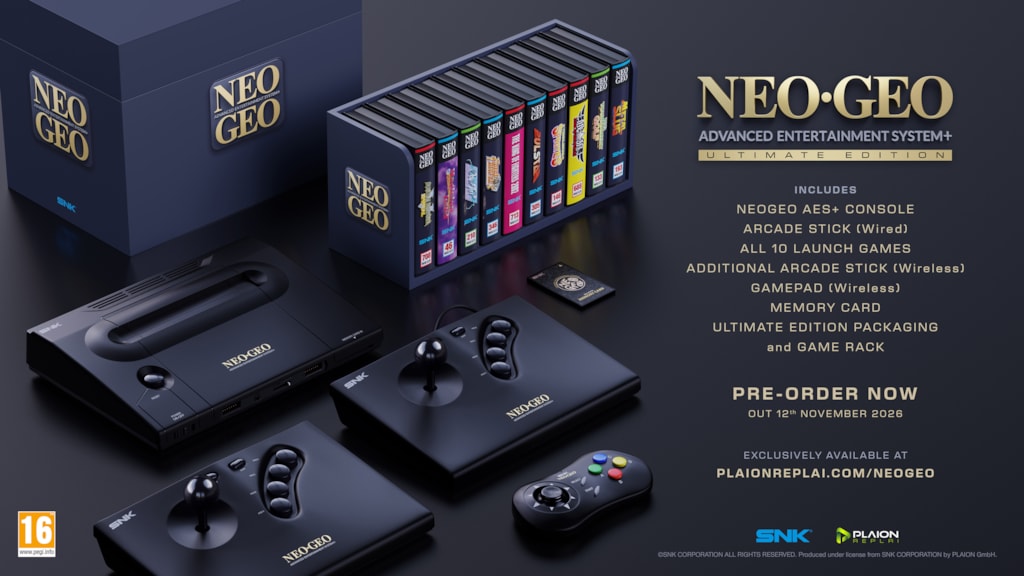
Meanwhile, for Neo Geo-enthusiasts who always wanted to dive into physical Neo Geo collecting but simply could not justify the financial barrier, there is a very different sense of excitement surrounding the AES+. Within the retro gaming scene, the idea of such an elaborate revival for such a niche platform almost feels unreal.
At the same time, original AES collectors are clearly holding their breath in anticipation of what this relaunch could mean for the market. That concern is understandable. Imagine investing thousands of euros, dollars, or yen into a collection, only to see both the hardware and software receive modern reissues at a fraction of the original cost.
Depending on which side of the fence you stand on, whether you are part of the “haves” or the “have-nots,” the fact that the console and cartridges are designed to mimic the original hardware so closely arguably opens up the platform in a way few retro hardware projects have managed before. Much of that comes down to the intended interchangeability between original and newly produced hardware and cartridges. Companies like Sega and Atari have explored similar territory before, but rarely with this level of focus on hardware compatibility, aiming at customers that still had cartridges laying around in the house they want to play, not create a new market.
As a point of reference, the base system is already available for pre-order and retail for $249 / €199, while games are currently priced at $79 / €79. In general, beyond the idea of affordability, the technical direction of the AES+ has generated considerable interest too. According to currently available information, the console is being developed around a newly produced ASIC derived from FPGA-based development work rather than traditional software emulation.
FPGA developer Jotego has publicly stated that his work formed the basis for the hardware implementation used in the AES+, and has argued that the resulting system should behave even closer to original hardware than the FPGA console recreations currently on the market.
“This is a reimplementation with chips manufactured from scratch that retain the original hardware but are distributed differently.”
That distinction matters. Rather than simulating the original hardware entirely through software emulation, the AES+ appears to aim for a hardware-level recreation using newly manufactured silicon. In theory, that could allow modern features like simultaneous HDMI and RGB output while still maintaining close compatibility with original cartridges and controllers.
Of course, none of this automatically guarantees perfection. Input latency, compatibility quirks, and long-term reliability will only become clear once the hardware is in the hands of consumers and preservation experts. Still, the involvement of respected FPGA developers has understandably increased confidence within parts of the retro hardware community.
Ironically, the very factors that make the AES+ appealing may also help preserve the value of the original hardware. The AES+ is still a distinct product from an original 1990s Neo Geo AES. Likewise, the newly manufactured cartridges are expected to use modern flash memory rather than original-style mask ROM boards. For many serious collectors, authenticity and historical originality remain a significant part of the appeal of collecting.
Is the fear of a market crash legitimate? Personally, I do not think so, at least not based on PLAION’s current plans. Rare collectibles have historically never collapsed in value simply because of reissues or reproductions. The real threats to collector markets tend to come from overexploitation of the original collectibles themselves, aggressive speculation, or the gradual extinction of the audience around them. We have seen those concerns surface around comics, coins, and stamps for decades. Reissues alone rarely damaged the value of original items within those communities.
That said, collector markets can still implode under their own weight. Especially when scarcity, exclusivity, and speculative value begin to outweigh active engagement with the medium itself. The original AES ecosystem already exists in a price range many retro enthusiasts would describe as disproportionately inflated relative to the size of the active Neo Geo community. In that sense, the Neo Geo collector scene walks a delicate line between preservation culture and luxury asset culture.
So yes, I expect the original Neo Geo collector market to largely continue functioning as its own closed bubble. The barrier to entry for original AES collecting is already so high that affordable reissues are unlikely to suddenly collapse the value of rare originals. Instead, the two markets may simply coexist.
“The AES+ is not replacing the original Neo Geo market. It is creating a second point of entry into a platform that had become financially closed off.”
In fact, some of the more affordable original releases, such as Art of Fighting, Ninja Combat, and Fatal Fury 2, could even benefit from renewed interest generated by the AES+. A new wave of players discovering the platform may ultimately increase interest in owning at least a few authentic original releases.
This is obviously not investment advice, but if you have ever been curious about original Neo Geo collecting, now may not be the worst time to keep an eye on the still-accessible end of the market, before it starts to rocket upwards.
